
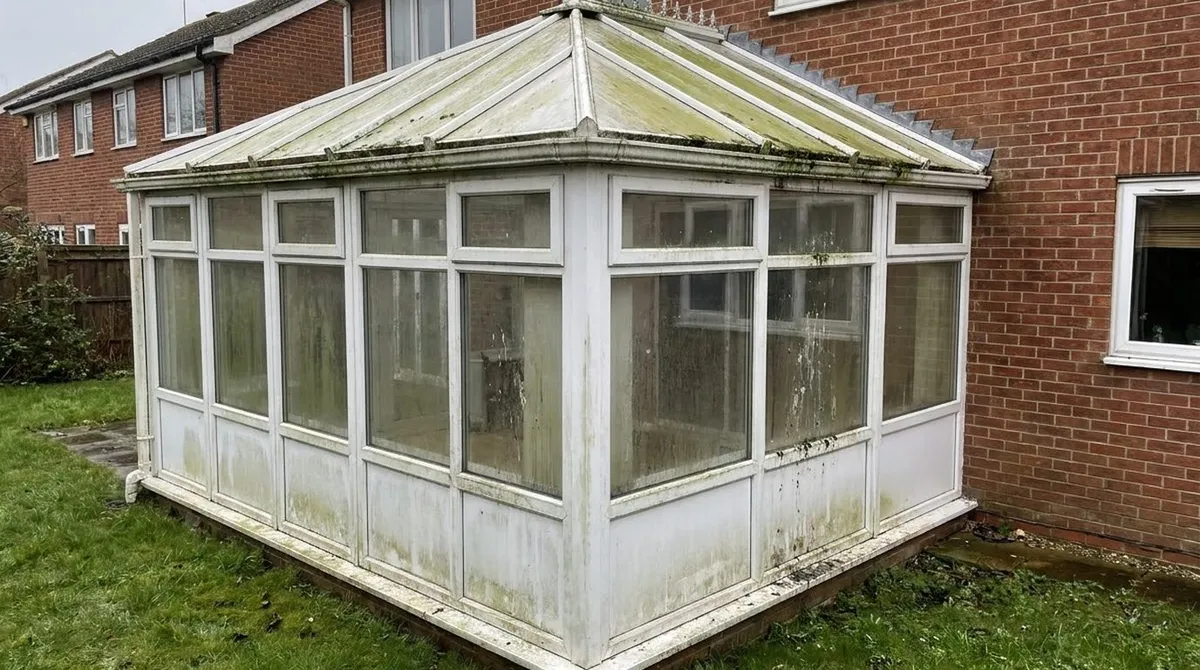
Never climb onto a conservatory roof. Clean it from the ground with a long-handled soft brush and plenty of clean water, or from a ladder resting on a solid wall or the frame, never the panels. Skip the pressure washer and anything abrasive.
Why you shouldn't climb on it
Conservatory roofs, glass or polycarbonate, aren't designed to take a person's weight. Falls through fragile roofs are a well-known cause of serious injury. Everything below can be done without going up there.
What you need
- A telescopic pole with a soft brush head (a car-wash brush on an extension pole works for small roofs)
- A hose, or buckets of warm water
- A little mild washing-up liquid if you're using tap water
- A stable ladder for the gutter, resting against the house wall, not the conservatory
The order to work in
- Clear the gutter and the box gutter first. If the outlet is blocked, all the dirty water you wash down will sit there.
- Brush off loose leaves and moss dry, working from the ridge down.
- Wet the whole roof and let it soak for a few minutes so the green film softens.
- Brush along the glazing bars, not across them. That's where the moss lives.
- Rinse from the top down with plenty of water.
- Do the side windows and frames last, because the roof water runs down them.
What not to use
- Pressure washers. They can push water past the seals, lift end caps and scratch polycarbonate.
- Bleach and strong cleaners. They can damage seals, harm plants below and leave a residue.
- Scouring pads. Polycarbonate scratches easily, and scratches hold dirt.
Tap water vs pure water
Tap water in Essex is hard, so a roof rinsed with it and left to dry can end up spotty. That's why professional cleaners use purified water: it has nothing in it to leave a mark, so no soap is needed and no drying either.
When to call someone
If the roof is large, very green, or you can't reach the middle safely from the ground, it isn't worth the risk. Our conservatory roof cleaning is a one-off job, done from the ground with pure water.
How do you clean polycarbonate without scratching it?
Use only a soft brush and plenty of water, and never scrub dry. Polycarbonate is softer than glass and scratches easily. Scratches hold dirt, so a scratched roof goes green again faster. Keep the surface wet the whole time, and let the water do the work rather than pressing hard.
If the ends of the sheets are open, don't spray water into the flutes. Dirt and water trapped inside the chambers can't be cleaned out and will show as dark lines.
How do you clean the glazing bars?
Brush along them, not across. The glazing bars and end caps are where moss and green film grip first. Run the brush along each bar from the ridge down, so the loosened muck goes towards the gutter, not into the joints. Check the end caps at the bottom of each bar are still seated afterwards.
What about the inside of the roof?
Use a soft mop on an extension pole and a mild solution of washing-up liquid in water. Wring it well so it doesn't drip onto the furniture. Wipe in straight lines and dry with a clean microfibre cloth on the pole. Move furniture out of the way first and cover anything you can't move.
How often should it be done?
Once a year suits many homes. Shaded roofs under trees go green faster and may need more. Our post on why conservatory roofs go green explains how to slow it down.